
How to automate your car rental company and reduce manual work by up to 80%
Discover how to automate critical processes in your rental company, reduce manual work by up to 80% and free the team for strategic actions. A complete guide with practical steps, verifiable ROI, real case studies and tracks for AI and WebMCP that connect technology to real results.
Direct response
Automating a rental company involves standardizing bookings, contracts, payments, fleet, and service with integrated technology (specific CRM, digital contracts, payment gateway, AI for customer service). The benefit is faster cycle time, fewer errors, quicker reservations, and verifiable ROI in weeks with block-by-block implementation and data governance.
You run a car rental company and know that the real impact is in operations: contract accuracy, frictionless billing, fleet availability, and fast customer service. Automating isn't just about putting new tools in the environment; it's about creating an ecosystem where reservations, contracts, payments, fleet, and service talk to each other to deliver predictable operations, lower cost per reservation, and a superior customer experience. This practical guide shows how to reduce manual work by up to 80% with a realistic implementation plan, clear ROI, and actionable steps for each stage.
What you will find in this guide:
- Detailed process mapping for end-to-end automation.
- Integrated technological solutions: digital contracts, rental CRM, fleet management, payment automation, and ERP/PMS integrations.
- Real cases of operational cycle improvement, with metrics and timeline.
- Data governance, security, and ROI metrics for each phase.
The automation journey is incremental: start with quick-value blocks, validate ROI and then expand to cover CRM, AI-assisted customer service, and analytical dashboards. Below, we present a roadmap with practical actions, internal references, and connections to AI, WebMCP, and AI-driven discovery to boost efficiency and scalability.
Quick index
- Why automate now
- Process mapping for automation
- Key technology solutions
- Practical case
- Data governance and ROI
- Implementation plan
- Conclusion and next steps
Why automate now
Automation is not an empty promise; it is the chain of actions that turns demand into a reservation, signed contract, processed payment, and fleet available for the next customer with minimal friction. Common challenges include manual contract errors, lengthy reconciliations, limited fleet visibility, and response time that impacts conversion. Automating reduces friction by standardizing flows and creating audit trails that give peace of mind to the financial and operational departments.
The ecosystem of tools for rental companies has matured: AI already delivers quick answers, digital contracts are common practice and recurring charges can be managed with fewer errors. The objective is clear: less rework, more speed, fewer mistakes, and greater customer satisfaction, directly reflecting in revenue and retention.
Process mapping for automation
The first step is to map the current flow and separate strategic from operational tasks. Practical methodology:
- List the steps from reservation to delivery (check-out) and return.
- Identify data rework between reservation, PMS/ERP, and finance.
- Prioritize steps with the greatest impact on cycle time and the customer experience.
- Define relevant metrics (reservation time, contract rejection rate, reconciliation time, NPS).
Real-world example: a rental company with 150 vehicles reduced the reservation closing time from about 28 minutes to 6 minutes by automating digitally signed contracts, integrating with finance and syncing data with the PMS, cutting 70% of contract returns due to data inconsistencies.
Key technological solutions
For effective automation, combine solutions that communicate with each other. Here are practical categories for rental companies:
- Reservation/CRM management specific to rental companies: customer journeys, personalized offers, and automatic follow-up.
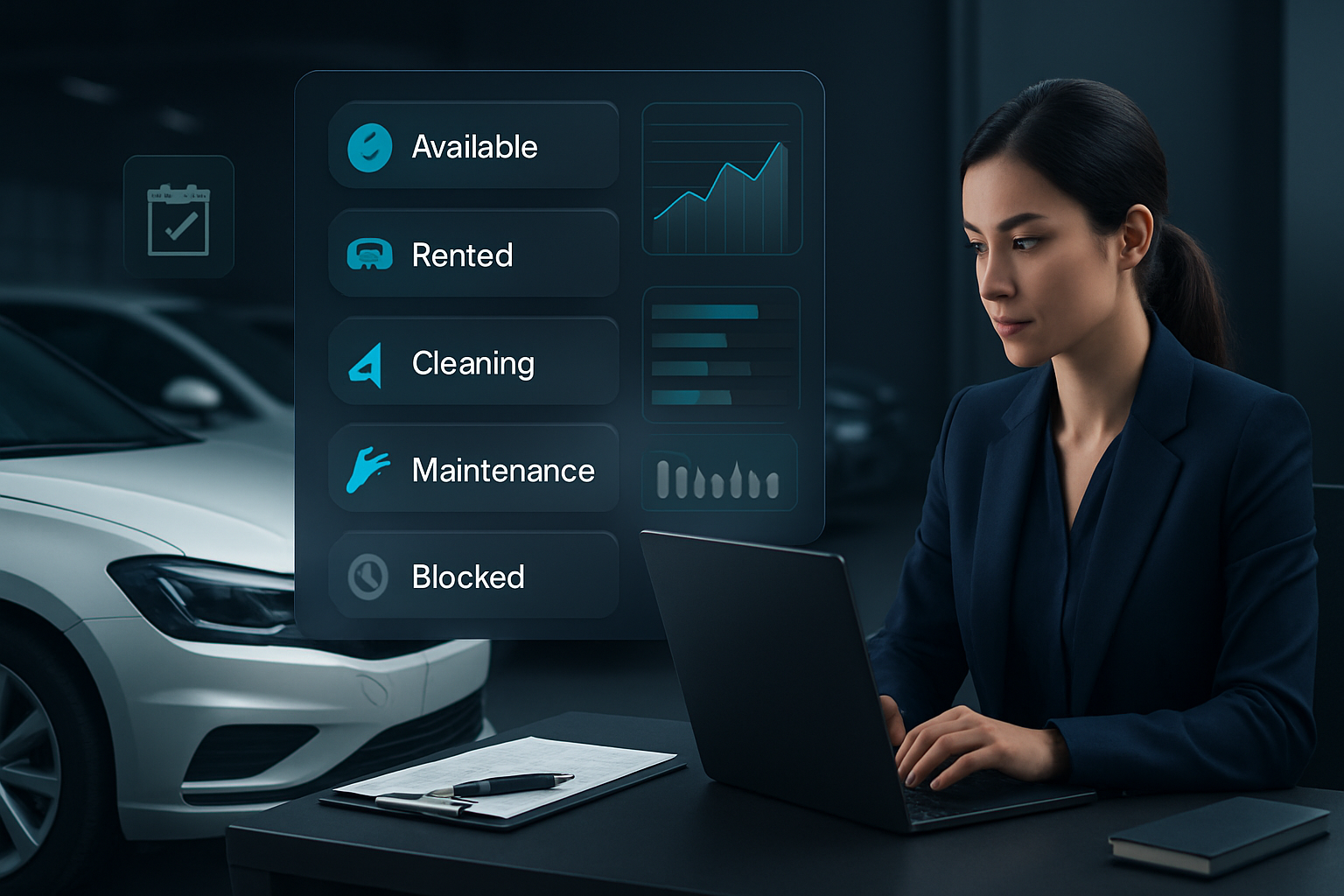
- Fleet management and maintenance: availability, scheduled maintenance, sanitization, and vehicle replacement.
- Contracts and payments automation: digital contracts, signatures, recurring charges, and automatic reconciliation.
- ERP/PMS/BI integrations: seamless flow between reservations, billing, accounting, and analytical dashboards.
- AI-assisted customer support: chatbots and support paths to reduce response time and increase conversion.
- Data governance and security: data quality, privacy policies, and access control.
Structure usage into automation blocks: start with digital contracts and payments, then integrate CRM and fleet management, adding AI as reliability and governance grow.
Step-by-step implementation examples
Recommended tools may include: car rental CRM, fleet management with monitoring, contract automation with electronic signature, payment gateway integration, and AI modules for customer service. See internal links to align expectations and ROI: How to increase a car rental company's revenue by up to 30% using technology without increasing the fleet, How to avoid chargebacks in rental companies and How to attract daily customers with Google Ads.
Case study
Before and after adopting an integrated solution for digital contracts, payments, and PMS integration, a rental company with 120 vehicles observed:
- Closing time per reservation from 28 minutes to 6 minutes.
- Contract errors dropping by more than 90%, with automatic data corrections.
- Recurring revenue representing 28% of the portfolio, with fewer chargebacks.
- HR freed to focus on expansion and CX improvement.
This scenario shows that automation is not just technology: it is a process transformation with solid data governance, visible ROI, and sustainable scalability.
Data governance and ROI
Reliable data is the foundation of any automation. Key points:
- Standardized data sources (reservations, contracts, payments, maintenance) with quality rules.
- Security policies, LGPD, and access control.
- ROI metrics by phase: cycle time, cost per reservation, conversion rate, churn, and TCO.
ROI arises from three axes: reduction of rework, increase in conversions, and liquidity improvement. Set quarterly goals and adjust the plan according to results.
Implementation plan
- Rapid assessment: map processes, bottlenecks, and data to clean.
- Modular solutions: start with digital contracts and payment automation; then integrate CRM and fleet management.
- Pilot project with clear KPIs (cycle time, data errors, ROI).
- Gradual expansion: AI for customer service, advanced dashboards and marketing automation.
- Data governance and changes: training, usage policies, and continuous improvement.
As a practical implementation reference, use the internally available content: How to increase a car rental company's revenue by up to 30% using technology without expanding the fleet, How to avoid chargebacks in car rental companies and contents such as How to attract daily customers with Google Ads, to align governance, ROI and regional expectations.
Conclusion and next steps
Automation of a car rental is an operational transformation with tangible returns. Start with the essential blocks (digital contracts and payments), quickly validate ROI and then expand to CRM, fleet management and AI-powered customer service. With well-established data governance, you create a solid foundation to scale automation year after year, keeping margins stable even with seasonal variations.
Ready to take the next step? Our team can design, measure, and execute an automation plan with ROI targets already in the short term. Explore our integrated solutions and schedule a strategic consultation.
Additional CTAs: Download our automation playbook for car rental companies and request a free diagnosis of your operation to identify areas of greatest immediate impact.
Search
Categories
Popular Posts


Gallery