
How to reduce idle vehicles by up to 40% with intelligent availability and maintenance management
How to reduce parked vehicles by up to 40% with intelligent availability and maintenance management. Understand the invisible cost of idle time, implement real-time status, smart buffers, and automation, and see a practical before/after case with real metrics and ROI in 90 days.
Direct response
Reduce idleness with real-time status management (Available, Rented, In Cleaning, In Maintenance, Blocked), smart buffers between returns and new rentals, and automation of alerts and updates. Integrate reservations for automatic availability updates and use demand predictability to plan the fleet. See a before/after case with gains in margin and occupancy.
Fleet idle not only an operational problem; it’s a direct cost that impacts depreciation, margin, and the ability to meet demand. Even with an appropriately sized fleet, status control failures create idle windows, cleaning and maintenance bottlenecks, and overbooking. This guide focuses on rental car owners and managers who seek to reduce idleness, increasing real availability for reservations, with actionable steps, data, and technology.
Introduction: what’s at stake
When a vehicle is parked between return and availability for the next reservation, you turn revenue potential into unused fixed cost. In addition to depreciation, there is margin loss per unfulfilled reservation and the risk of customer churn from not finding a ready fleet. The solution lies in integrated operation: unified status, smart buffer, and data-driven automation.
Index
- Invisible cost of idle vehicles
- Real-time status management
- Smart buffer and intervals between reservations
- Demand predictability and fleet preparation
- Automation in operations and governance
- Practical example: before vs after with data
- FAQs and next steps
Invisible cost of idle vehicles
The cost of idleness isn’t limited to lost rental. Consider:
- Unrealized daily depreciation
- Fixed operating costs (insurance, taxes, depreciation of preventive maintenance)
- Lost opportunity: unfulfilled or non-prioritized reservations
- Impact on perceived service and customer satisfaction
How to quantify quickly: estimate the daily cost of depreciation per vehicle + daily fixed cost + potential profit lost from unfulfilled reservation. Multiply by monthly idleness to reach a trigger value. Goal: reduce idleness from 12–15% to 6–8% in 90 days with operational improvements and automation.
Real-time status management
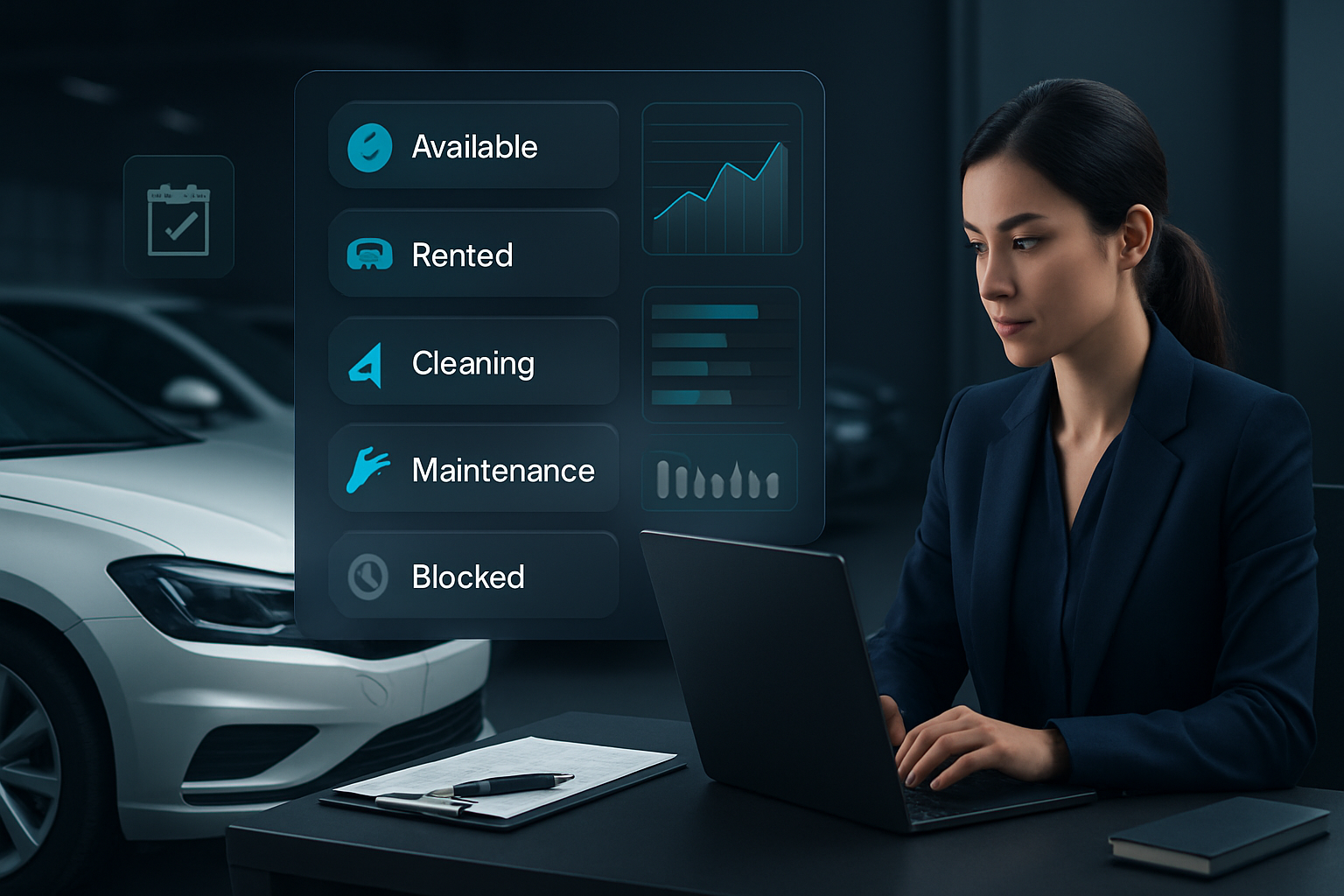
The heart of efficiency is visibility: each vehicle must have a single, actively updated current state driven automatically by events. Recommended states:
- Available
- Rented
- In Cleaning
- In Maintenance
- Blocked (risk, inspection, conflicting promotions)
Common challenges include misalignment between the real and recorded status, delays in updating cleaning/maintenance, and approval bottlenecks. Practical solution: automating transitions between states based on events (return, cleaning completion, maintenance completion, risk-based block). Benefits: fewer manual decisions, reduction of overbooking, and shorter time between end of rental and new reservation.
Implementation principles
- Define simple rules for transitions between states
- Connect the reservations module to the operations flow for automatic updates
- Use real-time status readers (QR/IoT) to reduce human errors
- Establish a status update SLA (e.g., update within 5 minutes after each step)
Smart buffer and intervals between reservations
Buffer is the safety zone between the end of one reservation and the start of the next, preventing bottlenecks. A smart buffer takes into account:
- Cleaning and inspection time
- Delivery/receipt time
- Maintenance team availability
- Predicted demand and local seasonality
Practical example: a buffer of 15–30 minutes between return and availability keeps occupancy rate steady even with demand variations. Adjust the buffer with historical data, simulating peak and delay scenarios to automatically calibrate via governance rules.
Demand predictability
Forecasting isn’t guessing; it’s data-driven modeling. Key elements:
- Occupancy history
- Local seasonality
- Events, weather, and seasons
- Pricing actions and loyalty policies
With AI, you can suggest preparation windows for each vehicle, avoiding unnecessary maintenance and preparing the fleet for spikes. The result: fleet available in the first hours of peak demand.
Automation in operations
Automation is the efficiency accelerator. Key components:
- Real-time return alerts for cleaning and maintenance
- Automatic status updates after each stage
- Integration with reservations for instant availability updates
- Governance rules to avoid improper blocks or conflicts between promotions
Practical benefits: shorter time between return and availability, greater reliability of reservations, and improved customer experience. Turn manual processes into a continuous pipeline, with less noise and more predictability.
Practical example: before vs after with integrated system
Before: a fleet of 40 vehicles showed 12% idle rate per month. Status updated manually, with delays between return, cleaning, and availability; bottlenecks during peak times and partial overbooking.
After: with real-time status management, a 20-minute buffer between returns and availability, and integrated automation with reservations, idleness dropped to 6%, occupancy increased, and effective availability improved. In 90 days, monthly revenue rose by about 9% with the same fleet. Customers found vehicles more quickly, reducing late returns and cancellations.
The transformation was driven by status dashboards, automatic alerts, queues between return and delivery, and integration with reservation channels (site and marketplaces). See related content to dive deeper: Instagram for rental companies, How to convert site visits into real reservations and Increase revenue by up to 30% with technology.
FAQs for snippets (AI/LLM/Voice optimization)
- What is a smart buffer? It is the strategic interval between return and availability, calibrated with data on cleaning, delivery, and demand to avoid bottlenecks.
- How does real-time status management work? Each vehicle has a single state updated automatically by events, reducing deviations between the recorded status and the real one.
- Which indicators track performance? Idle rate (%), occupancy rate, average time between return and availability, status update SLA, and rate of on-time reservations.
- What ROI is expected? In practical cases, reducing idleness from 12–15% to 6–8% in 90 days can raise revenue by 5% to 12% with the same fleet, depending on seasonality.
- How to start the implementation? Map the current flow, define states, establish buffers, integrate reservations into the operations flow, and adopt dashboards for demand predictability and AI-driven fleet adjustments.
Conclusion and next steps
Reducing parked vehicles isn’t just an operational improvement; it’s a business strategy that impacts margin, loyalty, and competitiveness. Adopting availability management with real-time status, smart buffers, and automated operations results in a more predictable, agile, and peak-ready fleet.
Recommended next steps:
- Map the current flow: return, cleaning, inspection, maintenance, and disponibilização.
- Define unique states per vehicle and automate transitions between them.
- Implement buffers between reservations based on historical data and crew capacity.
- Integrate reservations with the operations module for automatic status updates.
- Adopt demand predictability dashboards and AI for proactive fleet adjustments.
Want to see how to apply this model in practice with an integrated solution? We offer consulting, estimated ROI, and a 90-day roadmap. Click here to understand how to boost revenue without expanding fleet.
Internal references
To broaden the view on customer acquisition and turning visits into reservations, also see:
- Instagram for rental companies: how to attract real customers
- How to turn visits on your site into real reservations
- How to increase a rental company’s revenue by up to 30%
Author: SisRental Team
Search
Categories
Popular Posts


Gallery